
Bonding chemistry · ANAEROBIC ADHESIVES
Anaerobic Adhesives
Anaerobic adhesives are single-part liquids that cure in the absence of air and the presence of metal ions, which means inside close-fitting metal assemblies. They lock and seal threaded fasteners, retain cylindrical parts, and seal pipe threads, holding under vibration rather than bonding two flat surfaces.
Products
MightyLoc Anaerobic Adhesives products
How anaerobic adhesives cure
An anaerobic adhesive stays liquid while air can reach it and cures once it is confined between close-fitting metal parts, away from oxygen and in contact with metal ions. That is why it is applied to threads and shafts rather than open surfaces. Inactive metals can cure more slowly and may need an activator or primer. Confirm cure behaviour, thread coverage, and any activator on the product Technical Data Sheet.
Where it fits
Use anaerobic adhesives to stop threaded fasteners loosening under vibration, to retain bearings and bushes in housings, and to seal threaded pipe joints. They fill the small gaps between metal threads, so they are made for assembly, not for bonding two flat panels together. For surface bonding across mixed materials, a different chemistry is the right choice.
Strength grades
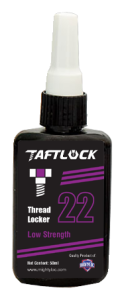
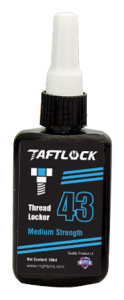
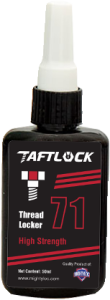
Anaerobic adhesives come in strength grades, from low-strength and removable with hand tools to high-strength and effectively permanent. Matching the grade to whether the joint must be serviced later is the main selection decision. The MightyLoc range includes Taftlock 22, Taftlock 43, and Taftlock 71. Taftlock 71 has a shelf life of two years. Confirm the grade, thread size coverage, and storage on each product Technical Data Sheet.
FAQ · ANAEROBIC ADHESIVES
Questions about Anaerobic Adhesives.
Anaerobic adhesives lock and seal threaded fasteners, retain cylindrical parts such as bearings in housings, and seal pipe threads. They cure inside close-fitting metal assemblies and hold against vibration. They are not intended for bonding flat surfaces. Confirm the application on the product Technical Data Sheet.
It cures in the absence of air and the presence of metal ions, so it stays liquid while exposed to air and sets once confined between close-fitting metal parts. That is why it is applied to threads and shafts rather than open surfaces. Confirm cure behaviour on the Technical Data Sheet.
Match the grade to whether the joint will be serviced. Low-strength grades allow removal with hand tools; high-strength grades are effectively permanent. The MightyLoc range spans these grades across Taftlock 22, 43, and 71. Confirm the grade and thread size coverage on each Technical Data Sheet.
Some metals are less reactive and can cure more slowly, so an activator or primer may be needed. Confirm whether your fastener metal needs an activator, and the resulting cure time, on the product Technical Data Sheet.