
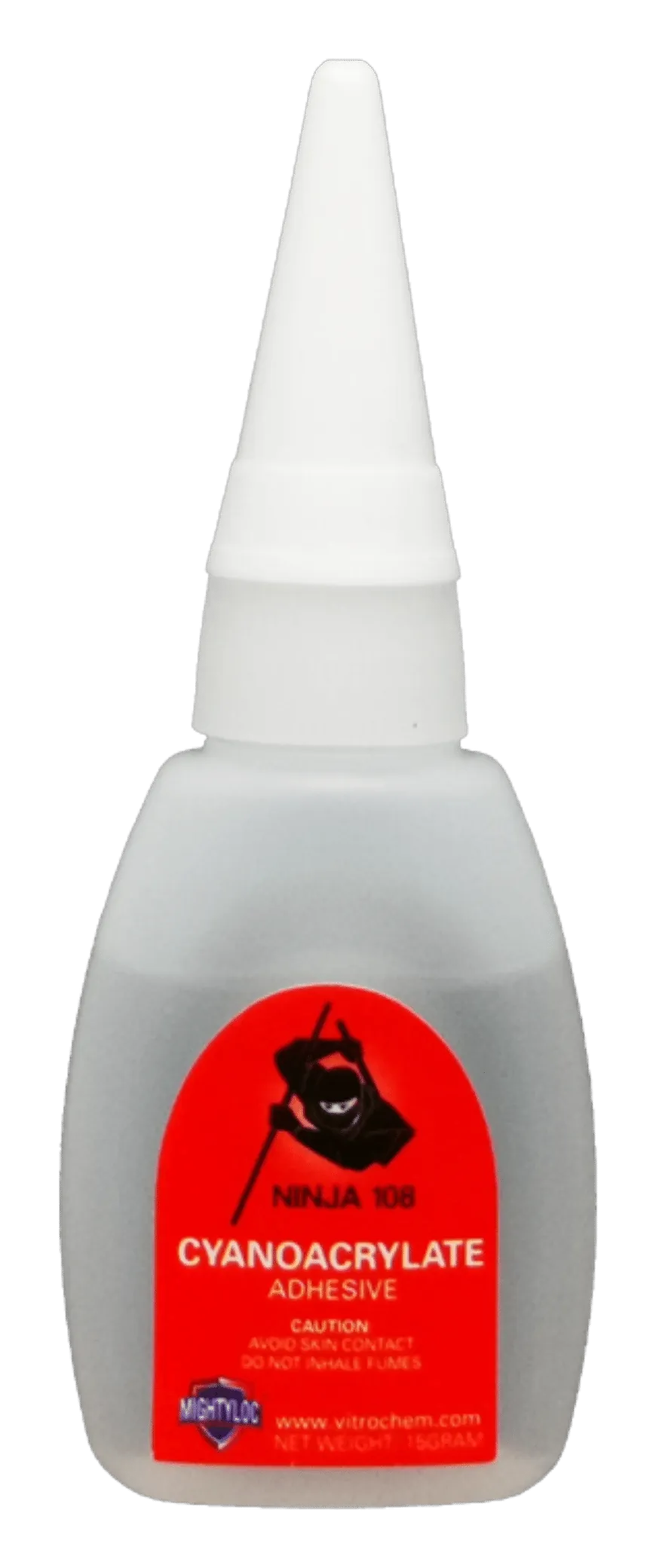
Pick cyanoacrylate when you need an instant bond across a wide mix of substrates at an external surface, and pick anaerobic when you need to lock, retain or seal close-fitting metal assemblies such as threads and cylindrical fits. They sit next to each other on the shelf but do nearly opposite jobs, so match the chemistry to the joint, not the speed.
Cyanoacrylate for open joints between mixed materials; anaerobic to lock threads and press-fit metal. Values from the Ninja 108 and TaftLock TDS.
Why these two get mixed up
Both are single-part liquids that cure fast without mixing, so buyers reach for either one when they want a quick result. The similarity ends there. Cyanoacrylate and anaerobic adhesives cure by different triggers and are built for different joints.
Cyanoacrylate, the chemistry behind Ninja 108, cures by anionic polymerisation set off by trace surface moisture in a thin film between two close surfaces. It is a general-purpose surface bonder for many materials. Anaerobic, the chemistry behind the Taftlock 71 range, cures only in the absence of air and the presence of metal ions, which means it cures inside a closed metal assembly, not on an open surface. One bonds almost anything at a visible joint, the other locks and seals metal parts that are clamped or threaded together.
What does cyanoacrylate do best?
Cyanoacrylate sets in seconds and bonds a very broad substrate range, including many plastics and rubbers as well as metals. That makes it the go-to for fast fixturing, small parts and quick repairs where you need the joint to hold almost immediately.
The trade-offs follow from how it cures. The bond line is naturally thin, so it offers minimal gap fill and needs close-fitting parts. As a class it is rigid and brittle, with low peel and impact resistance unless a toughened grade is used, and limited heat and humidity resistance. It is not the choice for structural loads, large gaps or joints that flex. Confirm the working window and any grade-specific limits against the current Technical Data Sheet.
What does anaerobic do best?
Anaerobic adhesives are made for metal assemblies. They handle threadlocking so fasteners do not vibrate loose, retaining of cylindrical fits such as bearings and bushings, thread sealing on pipe fittings, and gasketing. They fill the small gaps between close-fitting metal parts rather than bonding two flat surfaces.
They come in strength grades, from low and removable to high and permanent, so you can choose a Taftlock 43 for a fit you may need to service later, or a higher grade where the joint should stay put. Inactive or passive metals may need an activator or primer to cure reliably. Match the grade to the thread or diameter coverage on each product TDS, and do not rely on published removal or break temperatures because those are not given.
Does the warm, humid climate change the choice?
It mainly affects cyanoacrylate. Because cyanoacrylate is moisture-triggered, the warm and humid conditions across Singapore and South East Asia generally speed its cure, which can shorten the working and skin time you have to position parts. Plan for a shorter window and confirm it on the TDS for your local conditions.
Anaerobic cure depends on the absence of air and the presence of metal, not on ambient humidity, so the climate has far less effect on its working time. For both chemistries, the cure-time guide and each product’s TDS are the authority. Keep parts clean and dry where the process allows, and verify grade behaviour rather than assuming a fixed time.
| Property | Cyanoacrylate (Ninja 108) | Anaerobic (Taftlock range) |
|---|---|---|
| Cure mechanism | Anionic polymerisation triggered by trace surface moisture, sets in seconds | Cures in the absence of air and presence of metal ions, inside a closed assembly |
| What it joins | Surface-to-surface bonding of mixed substrates | Locks, retains and seals close-fitting metal parts and threads |
| Shear strength (per ISO 4587 / ASTM D1002) | Low to medium, rigid bond line, not for structural loads | Set by grade, from low and removable to high and permanent on metal |
| Gap fill | Minimal, needs thin bond lines and close-fitting parts | Fills the small gaps between close-fitting metal threads and fits |
| Substrate range | Very broad, many plastics, rubbers and metals | Metal assemblies, inactive metals may need an activator or primer |
| Best use | Fast fixturing, small parts, quick repairs | Stopping fasteners loosening under vibration, sealing pipe threads, retaining |
How to choose
- If the parts are different materials, such as plastic to metal or rubber to metal, and you need an instant surface bond, choose cyanoacrylate. Ninja 108 is the cyanoacrylate to start from.
- If the job is a threaded fastener, a pipe fitting or a press fit between two metal parts, choose anaerobic. Pick the strength grade by whether you ever need to take it apart again, low and removable up to high and permanent across the Taftlock 71 range.
- If the gap is wide or the joint must flex or carry structural load, neither of these is the right tool, because cyanoacrylate is thin and brittle and anaerobic is for close metal fits. Ask MightyLoc for a structural or elastic grade instead.
- If you are bonding on a passive or inactive metal with anaerobic, plan for an activator or primer, and if you are working fast in humid conditions with cyanoacrylate, plan for a shorter working window.
- Whichever you pick, confirm strength, gap and working time against the current TDS in the TDS library before you commit a production run.
Frequently asked questions
It is not the right tool. Cyanoacrylate cures in a thin film at an exposed surface and is rigid and brittle, so it does not handle vibration or the small gaps inside threads well. Anaerobic threadlockers are designed to cure inside the closed thread and resist loosening. Pick the [Taftlock 71](/products/taftlock-71/) range and confirm the grade on its TDS.
No, as a class anaerobic adhesives cure only with metal ions present and air excluded, so they do not cure reliably on plastics or rubbers and are not surface bonders. For mixed substrates including plastics and rubbers, use a cyanoacrylate such as [Ninja 108](/products/ninja-108/). Confirm substrate suitability on the TDS.
It depends on the joint, so a single strength figure is misleading. Anaerobic strength is set by grade, from low and removable to high and permanent on metal. Cyanoacrylate gives a fast but rigid and relatively brittle surface bond with low peel. Compare against the shear and peel methods named in your TDS rather than a headline number.
Mostly cyanoacrylate. It is moisture-triggered, so warm humid air generally speeds its cure and can shorten the working window you have to position parts. Anaerobic cure depends on metal and the absence of air, not humidity, so it is far less affected. Confirm the working time for your conditions on the TDS.
No. Cyanoacrylate needs a thin bond line and close-fitting parts, and anaerobic only fills the small gaps between close-fitting metal threads and fits. For a wide gap or a flexible or load-bearing joint, neither is right. Contact MightyLoc for a structural or elastic grade and confirm gap capability on its TDS.