
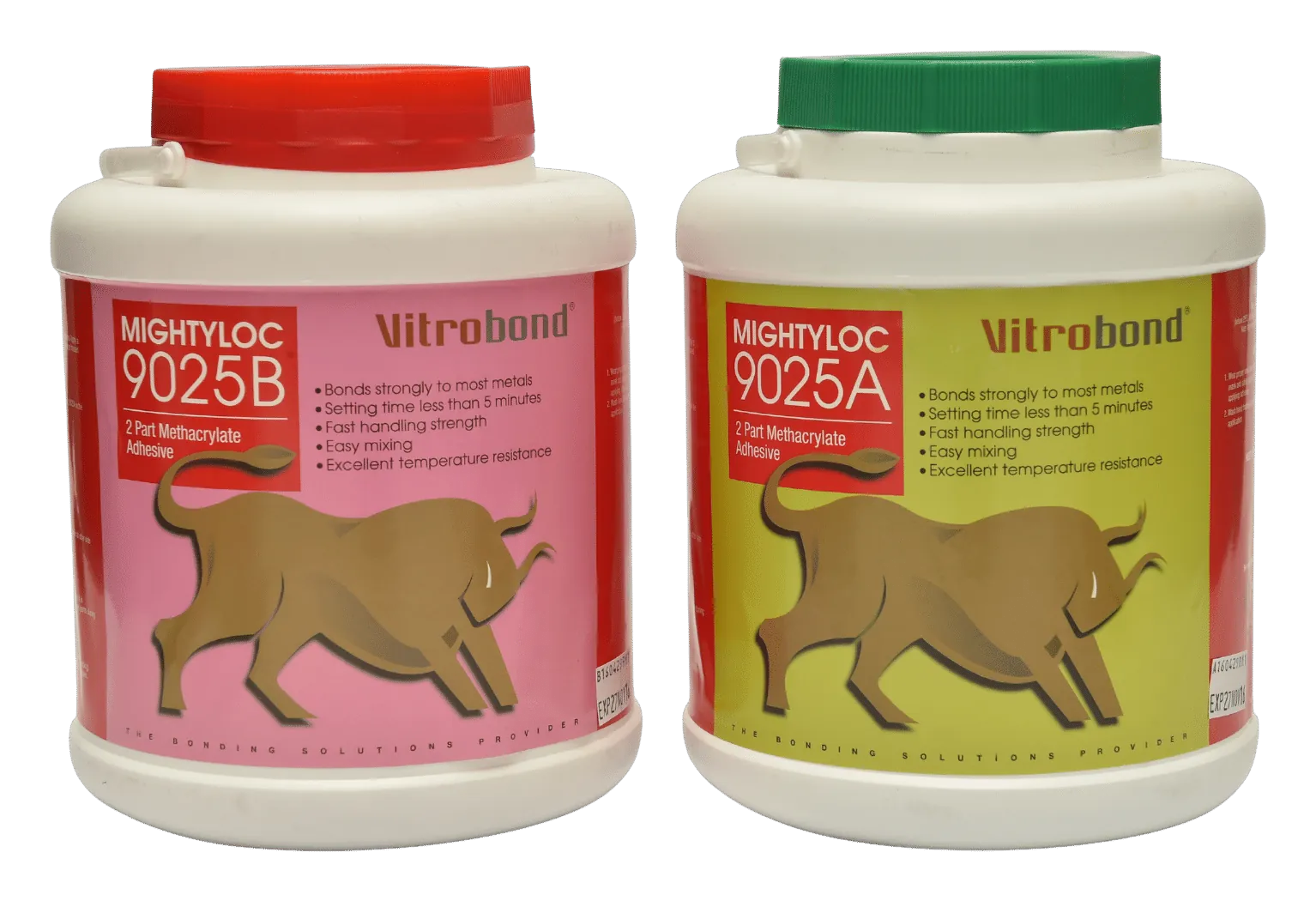
MightyLoc 9025 is a two-part methacrylate (structural acrylic) adhesive built for demanding metal assemblies. It pairs high shear strength on metal with toughness, tolerates lightly oily or minimally prepared surfaces, and spreads load across the whole joint instead of concentrating it at welds or rivets. Always confirm grades against the 9025 TDS.
Figures from the MightyLoc 9025 TDS. The TDS does not state a service-temperature range, so none is shown here.
What is MightyLoc 9025?
MightyLoc 9025 is a two-part methacrylate adhesive, also called a structural acrylic. You meter and mix the two parts, then a reactive cure builds a load-bearing bond. Its technical data sheet is metal focused, so the product is positioned for bonding metal to metal and dissimilar metals in assemblies that carry real load.
Methacrylate sits in the structural class alongside epoxy, but with a different balance of properties. As a chemistry class it gives high strength together with toughness, meaning better peel and impact resistance than a rigid epoxy. That toughness matters when a joint sees vibration, flexing or thermal movement rather than a single static pull. For the verified mechanical figures, check the current TDS before you specify a grade.
Why does methacrylate chemistry suit metal bonding?
Two properties make methacrylate practical on the production floor. First, it tolerates minimally prepared or lightly oily surfaces better than many structural adhesives, so you spend less time on aggressive cleaning to get a sound bond. You still prepare the surface, but the chemistry is more forgiving of residual oils from forming or machining.
Second, methacrylate combines high shear strength on metal with genuine toughness. A bonded lap joint spreads stress across the full overlap area instead of concentrating it at a weld spot or a rivet hole. That distributed load path reduces stress risers, helps with fatigue life, and can lighten an assembly. Treat these as class and product positioning, and confirm the actual shear value, tested per ISO 4587 or ASTM D1002, on the 9025 TDS.
Where does MightyLoc 9025 fit?
9025 fits load-bearing metal assemblies, joints between dissimilar metals, and applications where you want to reduce or replace welding and riveting. Bonding avoids the heat distortion of welding and the point loads and drilled holes of riveting, while sealing the joint at the same time. That makes it a useful tool across metal fabrication work in South East Asia.
Methacrylate as a chemistry class also bonds composites and many plastics, which is why it is popular in mixed-material structures generally. For MightyLoc 9025 specifically, follow its metal focused TDS rather than assuming plastic or composite suitability. If your assembly mixes metal with another material, contact MightyLoc so the right grade is matched to your substrates and loads.
What service conditions can it handle?
The product information cites a service range of roughly -40 to +150 C, with short-term excursions above that. This covers most indoor and many outdoor metal assemblies, but the exact continuous and peak figures depend on the grade and the joint, so always confirm them on the 9025 TDS.
Singapore and the wider region run warm and humid year round, with high UV and, in coastal work, salt air. These are durability considerations for any bonded joint. Cure behaviour, temperature limits and environmental resistance should be read from the TDS for your conditions, not assumed. The service-temperature guide gives general orientation, but the data sheet is the selection authority.
Key facts at a glance
These are positioning points, not selection authority. Confirm every value on the current data sheet in the TDS library.
- Chemistry: two-part methacrylate, also called structural acrylic.
- Format: meter and mix two parts, then a reactive cure.
- Primary substrates: metal and dissimilar metals (TDS is metal focused).
- Strength class: structural, high shear strength on metal with added toughness.
- Surface tolerance: handles minimally prepared or lightly oily surfaces better than many structural adhesives.
- Service range: roughly -40 to +150 C with short-term excursions, per the product information; confirm on the 9025 TDS.
- Where it fits: load-bearing assemblies, dissimilar metals, reducing welds or rivets.
How to get the best bond with 9025
- Clean the metal to remove loose dirt, then degrease so only light residual oils remain, the kind methacrylate is designed to tolerate.
- Abrade the bonding faces to give the adhesive a fresh, keyed surface, then remove the dust before bonding.
- Dry-fit the parts first to confirm alignment, fixturing and the bond gap before you mix anything.
- Follow the mixing ratio, working time and cure schedule on the 9025 TDS; the cure-time guide explains the general principle.
- If the assembly carries real load or mixes substrates, contact MightyLoc so the grade is matched to your joint, supplied from Singapore across the region.
Frequently asked questions
It works differently. A 9025 bond spreads load across the whole overlap area rather than concentrating it at weld spots, which helps with fatigue and avoids heat distortion. It also seals the joint. Whether it suits your load case depends on joint design and the verified shear figure, so confirm suitability on the [9025 TDS](/products/mightyloc-9025/).
Yes. Methacrylate is more forgiving of light residual oils than many structural adhesives, which saves preparation time, but it is not a substitute for surface prep. Clean off loose dirt, degrease, and abrade the bonding faces for the strongest, most repeatable bond. The 9025 TDS lists the recommended preparation steps.
Methacrylate as a chemistry class bonds composites and many plastics, which is one reason structural acrylics are popular in mixed-material work. MightyLoc 9025 itself has a metal focused TDS, so follow that data sheet rather than assuming plastic suitability. For mixed substrates, contact MightyLoc so the right grade is matched to your materials.
The product information cites a service range of roughly -40 to +150 C, with short-term excursions above that. The exact continuous and peak limits depend on the grade and the joint, so always confirm the published figures on the [9025 TDS](/products/mightyloc-9025/) for your application and conditions.
Match the chemistry to the job. Use 9025 for load-bearing metal-to-metal and dissimilar-metal assemblies. Anaerobics like [Taftlock 71](/products/taftlock-71/) suit threadlocking and retaining inside close-fitting metal parts, while cyanoacrylate suits fast small-part fixturing. Confirm the right choice against each product TDS in the [TDS library](/tds/).