
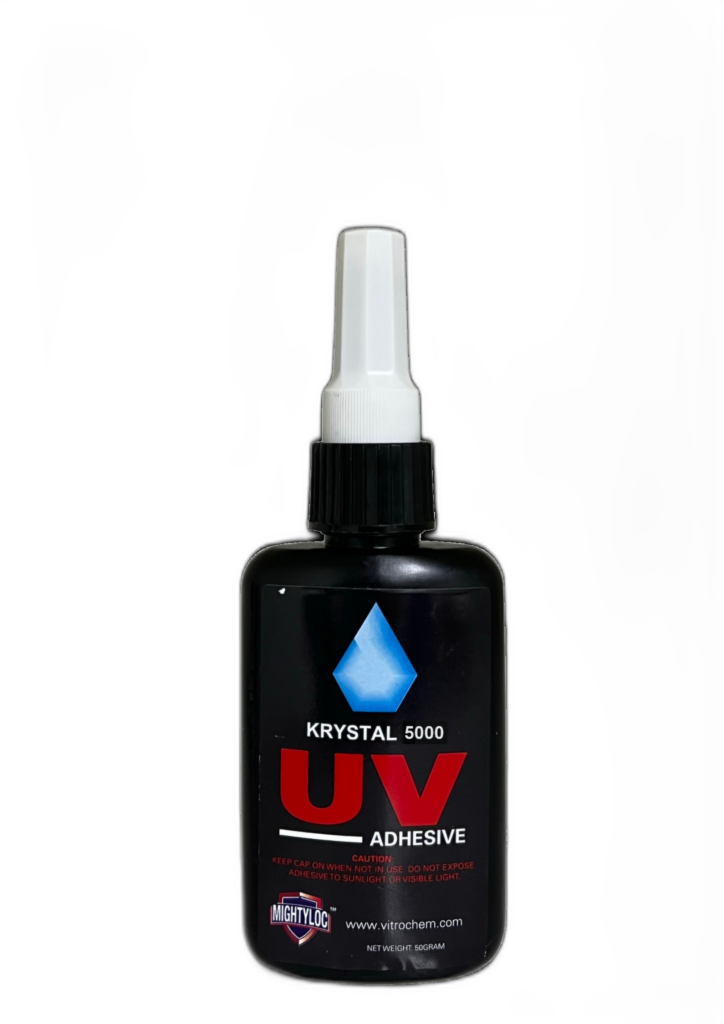
Krystal 5000 is an ultra-low-viscosity UV adhesive for bonding glass to glass and glass to stainless steel. It is colourless and transparent in thin films, so edge bonding between glass stays seamless.
PRODUCTS · UV ADHESIVE
Krystal 5000
Ultra-low-viscosity UV adhesive for seamless glass-to-glass and glass-to-metal bonding.
Sibling products: Krystal 1000 Krystal 2000 Krystal 3000 Krystal 4000
UV AdhesiveMetalGlass
Service temp
-40 to 100 °C
Cure speed
On UV exposure
Headline properties for Krystal 5000. Full specification is available on request.
Specifications last reviewed
Specifications
| SKU | 5000 |
|---|---|
| Chemistry | Acrylic resin |
| Appearance | Colourless |
| Viscosity | 80-130 cps (at 25°C, S14 100 rpm) |
| Fixture time | On UV exposure |
| Service temperature | -40°C to 100°C |
| Shear strength | 131 Kg/cm2 |
| Shelf life | 1 year (stored 15 to 25C) |
| Packaging | 50 g and 1 kg anti-UV bottle |
Substrate compatibility
- Metal
- Glass
Technical Data Sheet
Download the current Technical Data Sheet for full specification, handling, and cure data. The complete TDS library cross-references every MightyLoc family by chemistry, substrate, and service window.
Compliance
RoHS statements and Safety Data Sheets for this product are available on request. Contact the MightyLoc team and we will send the current documents.
Glass bonding · 3 points
01 / 03
Apply to the joint
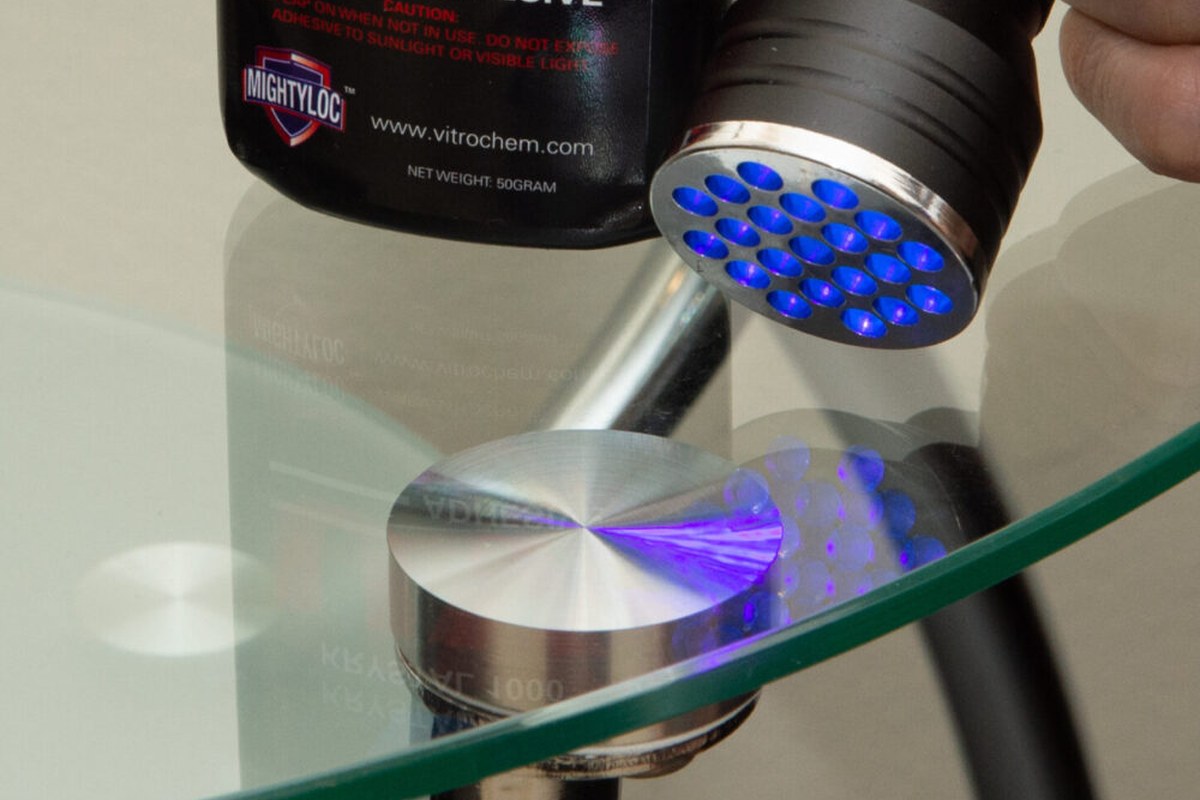
Run a thin film of Krystal 5000 along the joint between glass and stainless steel, or between two glass parts. The 80-130 cps adhesive draws into the joint by capillary action before it is cured.
02 / 03
UV cure
Hold a UV lamp at 365nm close over the joint, above 50 mW/cm2. The adhesive stays liquid until the light reaches it, so the glass and metal can be aligned first.
03 / 03
Glass to stainless steel
Krystal 5000 reaches a shear strength of 131 Kg/cm2 on glass to stainless steel and 118 Kg/cm2 on glass to glass. The colourless film keeps the bonded fitting looking seamless.
Tap a point on the image to see where and how to apply.

Display & crafts · 3 points
01 / 03
Invisible joints
Bond glass display and award parts so the join disappears. Krystal 5000 is colourless and transparent in thin films, with a refractive index of 1.4769.
02 / 03
Clear assemblies
Keep the film thin across the mating face. The ultra-low viscosity gives excellent capillary penetration into tight joints, for a seamless, clear bond between glass panels.
03 / 03
High clarity work
Suited to fine glass and metal display work. The cured bond holds from -40 C to 100 C with good weather and ageing resistance.
Tap a point on the image to see where and how to apply.
Application guidance last reviewed
Technical tools: Cure-time guide Service-temperature guide Substrate-pair selector
Frequently asked questions
Krystal 5000 bonds glass to glass and glass to metal, including stainless steel. It reaches a shear strength of 131 Kg/cm2 on glass to stainless steel and 118 Kg/cm2 on glass to glass.
The low viscosity gives excellent capillary penetration, so the adhesive wicks into tight edge joints between glass for a seamless, clear bond.
Krystal 5000 cures under 365nm ultraviolet light at an intensity above 50 mW/cm2, per the Vitrochem TDS. It stays liquid until the light reaches the joint, so parts can be aligned first, which suits seamless glass edge work.
Cured Krystal 5000 has a service temperature range of -40 C to 100 C per the Vitrochem TDS, with a cured hardness of Shore D 68 and good thermal and shock resistance.
Krystal 5000 is colourless and transparent in thin films, with a refractive index of 1.4769 per the Vitrochem TDS. This keeps edge bonds between glass panels visually seamless.
No. Krystal 5000 has 0% solvent content per the Vitrochem TDS, so it cures with minimal shrinkage and no residue, which matters for a clear glass bond.
Krystal 5000 has a 1-year shelf life in its original unopened container, stored between 15 C and 25 C away from light. It is supplied in 50 g and 1 kg anti-UV bottles to keep stray light from starting a premature cure.
Both are low-viscosity UV adhesives for glass. Krystal 4000 is thinner at 45-65 cps and is aimed at glass face-to-face and edge bonding. Krystal 5000 is 80-130 cps and is built for glass-to-glass and glass-to-metal joints, reaching a shear strength of 131 Kg/cm2 on glass to stainless steel.